


High quality tuition in essential critical thinking skills
Please note this website is currently being updated in preparation for our new programme and its functionality limited. While this is the case, please direct any enquiries to info@kritikos.co.uk
Think clearly.
Judge wisely.
Our full KRITIKOS programme is being made available to the public for the first time; first teaching Autumn 2026. Find out more here
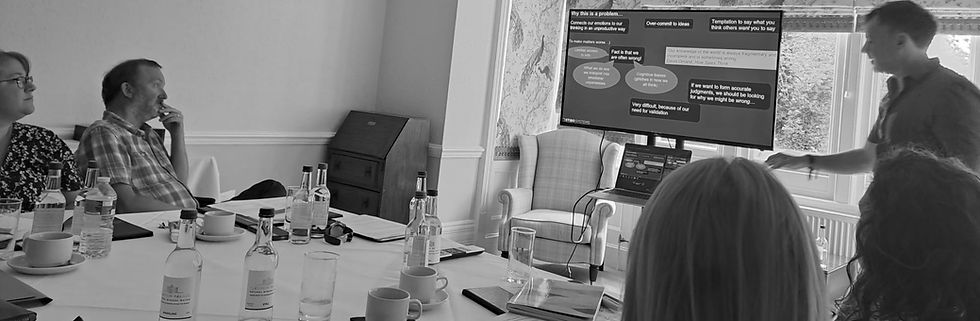
ONLINE COURSES: Essential & Advanced Critical Thinking
Work-based trainings and consultancy
Leadership programmes
Introducing KRITIKOS - a new approach to critical thinking
Unlike traditional approaches, KRITIKOS is built around how people actually think - intuitive, unconscious, and shaped by real‑world contexts.By looking at how to combine detached analytical, evidence-based thinking with instinct, sensitivity and real world experiences, it teaches people how to judge not just well, but wisely.


What you get...
HIGH QUALITY SUPPORT &TRAINING delivered by a skilled teacher, author and critical thinking examiner
CLEAR PRACTICAL STRATEGIES AND FRAMEWORKS for developing stronger, wiser judgment...
... and to share your thinking more effectively
Joe is a skilled and experienced teacher and teaching coach as having unusually high subject knowledge in critical thinking. He sets out to make his training enjoyable, useful and deeply impactful.
The strategies and frameworks Joe shares are designed to be intuitive and easy to apply; his workshops examine what is needed to think critically, but also what is needed to think and judge both confidently and wisely
It's no good being able to reach sound judgments if you are unable to communicate them effectively - especially with those who may agree! The dynamics behind sharing thinking are deeply embedded in the KRITIKOS approach.
Joe Chislett has been blah over 25 years

20 year mission
Although it is a fresh approach, it didn't arrive overnight. KRITIKOS is the product of Joe Chislett's 20 year mission to provide an approach to teaching thinking skills that is in tune with the human mind and the contexts we think in.
Those familiar with his work will know how he has long sought to combine the discipline of logical thinking with human emotion, creativity and intuition. He draws on his expertise in critical thinking alongside more "human' areas such as teaching Drama and Creative Writing.
His aim: to provide high quality support and training in critical thinking - support that stands out for both its effectiveness, and for being genuinely transformative.


"I wanted to create an approach to teaching critical thinking that I felt was not just enjoyable or effective but genuinely meaningful...
I do this by:
[1] addressing the actual, practical needs and challenges people face;
[2] only using things that I know help (because I use them myself);
[3] connecting to bigger, wider questions of human cognition and judgment more generally; and of what it means to judge not just well, but wisely."
Joe Chislett, Founder KRITIKOS

"Wisdom requires combining detached, analytical thinking with felt and lived experience"
Judge wisely. Choose KRITIKOS.


"Not only did the session get me thinking - it was surprisingly enjoyable. I enjoyed the blend of humour and seriousness. I didn't think that a session on critical thinking could be so much fun!"
Katherine, Assistant Head Teacher, Waingels College

Courses and workshops
WORK-BASED TRAININGS
Standalone workshops and bespoke training in "Essential critical thinking"
"Stronger, Wiser Judgment"
For leaders and decision-makers
ONLINE COURSE
"Essential Critical Thinking"
[6 hours]
4 x 90 min workshops
"Advanced Critical Thinking"
[4.5 hours]
3 x 90 min workshops
Whether it's work-based training for businesses, teams or organisations, or the publicly available online courses, here is the content we cover...
What you learn
Overview
How to do this wisely/ judiciously
1/
Clear framework and principles/ Better mental framework for how to approach claims, ideas, questions, arguments, evidence, data, theories, models
[value/ benefit] make better/ more discerning Js about what to believe, value, do...
[Expansion] Simply knowong the tools and concepts for logical, analytical thinking doesn't mean you will be thinking wisely; it's possible to use the tools in a 'motivated' way; our course shows you not just how to use them, but how to use them WISELY
2/
insights into how humans think and process information, the different factors going on, consvious and unconscious etc
[value/ benefit] A wiser, more self-aware thinker; better able to share your thinking with others
In a bit more detail...
NEW: Publicly available courses (Online workshops)
Essential Critical Thinking
6 hours (online group workshops; 4 x 90 min)
-
What it means to go ‘beyond’ fact and opinion and how this helps us treat the information we encounter – whether from people or AI
-
Factors – both conscious and unconscious – that affect our thinking; what this means not just for our own thinking, but our attempts to share thinking with others
-
How evidence works and how to use and interpret it more effectively (e.g. the difference between evidence and examples, the asymmetry between confirmation and falsification)
-
How to approach arguments, explanations, models and theories more cautiously and discerningly; how do reasons work, logically and psychologically
-
The power and also limitations of logical, evidence-based thinking: how and why we need to combine it with lived experience, empathy, imagination and intuition in order to truly think and judge not just well but more wisely!
Advanced Critical Thinking
4.5 hours (online group workshops; 3 x 90 min)
Builds on the Essential programme by looking at:
-
Pressure-testing thinking: testing ideas and arguments; learn how to expose and challenge hidden assumptions
-
Preparing to share your thinking (to a potentially hostile audience) Anticipating and responding confidently to objections
-
Challenge the thinking of others in ways that are powerful yet non-confrontational
-
Linking thinking to action
-
Critical and creative thinking
For teams or organistions:
Work-based trainings (in-person or virtual)
Standalone workshops or full courses in Essential or Advanced Critical Thinking
Bespoke trainings
Stronger, Wiser Judgment for Leaders and Decision-makers
Wisdom requires more than logic and data...
Our courses look at the role individual experience and intuition, moral and contextual sensitivitiy/ awareness play in 'judgment', and how to balance against detached, analytical, evidence-based thinking
[Expanasion] How each tells us something the other can't see/ is blind to; why wise thinking needs both, and how to engage both
Meet your teacher
Hi, I'm Joe. I've worked in the field of critical thinking for 25 years - as teacher, author, examiner and consultant. I've also worked in areas such as conflict resolution and preventing violent extremism, as well as having taught English, Philosophy, Drama and Creative Writing. I'm interested in human thinking in the broadest sense - from the analytical and logical, to the emotional, intuitive and instinctive. I'm an experienced teacher and teaching coach, and am interested in how we learn - my trainings and workshops reflect this. As well as having papers published in academic journals such as Nature, I write and perform poetry and run poetry workshops in schools. (If you want to find out more about my background, about the tests I write for and the papers I've written, and the story of how KRITIKOS came about see here)

Our Clients Say

“The critical thinking course has made me more conscious of my thinking and equipped me with practical and easily applicable points for critical thinking. The refresher documents on the four principles provided after the course were particularly helpful, reinforcing my memory and awareness of these key points. It's heightened my awareness of biases in communication, enabling me to communicate more effectively. I feel more confident and empowered in my thinking and this course has truly helped me in my ways of communicating, both professionally and personally.”
Anne-Sofie, Graduate Training Programme, Stibo Systems, Aarhus, Denmark
BACKGROUND

KRITIKOS: the origin story
KRITIKOS evolved from my work in both logical, analytical thinking, but also in more 'human' areas, for example teaching Literature, Drama, Creative Writing, and on emotionally-charged projects and contexts, which involved actual behavioural change (projects to prevent violent extremism).
From out of this combination, I saw what was powerful about analytical, critical thinking; I saw what it was that I and other critical thinking experts could do, why we could ask and answer questions that others routinely got wrong.
I also saw that, for critical thinking to work in real life, amongst real people and in real situations, it needed to take into account how we really think and operate as people: the role of emotion and instinct in all of our thinking and interactions; the fact that thinking - good thinking - is also necessarily creative.
Above all, I felt that a lot of what passes for critical thinking training or support is unhelpful: either vague, impractical, and in some cases even misleading. I decided to teach only the things I actually use; that are actually helpful; and that are consistent with real people and the contexts we think in.
My background
My background spans teaching and examining higher order thinking skills as well as teaching Philosophy, English Literature, Drama, and Creative Writing. I have worked with emotionally vulnerable people on initiatives to prevent violent extremism, and run poetry workshops in local primary schools. I have delivered workshops and training programmes to both schools and businesses (see testimonials.) A skilled teacher and teaching coach, I pride myself on delivering engaging trainings that fully engage all aspects of people's thinking,
In terms of my work in thinking skills, I have over 20 years experience designing and writing for high stakes aptitude tests, including questions that assess critical thinking, data analysis, logical thinking and problem-solving. I was a senior examiner for the UK A level in Critical Thinking, and am currently a senior examiner for the International A level Knowledge and Inquiry. I have co-authored textbooks and papers in Nature magazine on how to assess evidence across different academic fields, as well as acting as a consultant on programmes to help people assess claims in health and medicine. Prior to teaching I worked in radio.

